
Species field guide
Blue Jay identification guide
Cyanocitta cristata · Crows, jays, and magpies · Corvidae
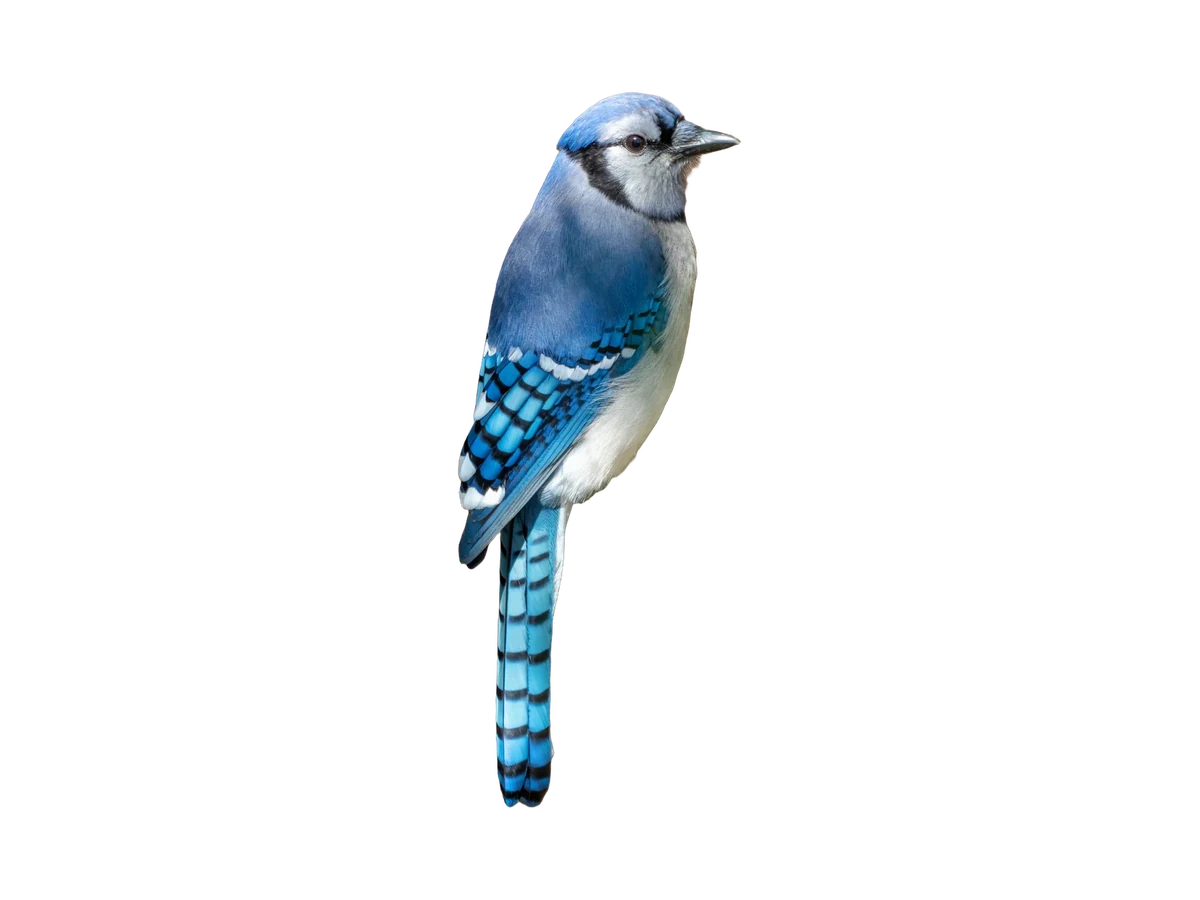
Observation focus
How to identify the Blue Jay.
Blue Jays are large, crested songbirds with bold blue, black, and white patterning. They are social, intelligent corvids that carry and cache acorns, visit feeders, and often announce themselves before they come into view.
- Blue crest and upperparts paired with a pale face and underside.
- Black bridle or necklace framing the face and throat.
- Blue wings and tail crossed by strong black-and-white bars.
Meet the bird
What kind of bird is the Blue Jay?
Blue Jays are large, crested songbirds with bold blue, black, and white patterning. They are social, intelligent corvids that carry and cache acorns, visit feeders, and often announce themselves before they come into view.
Where to look
Where can you find the Blue Jay?
Listen first along wooded edges, then watch for a long-tailed bird crossing an opening with steady wingbeats. At feeders and oak trees, check the crest, white face, black bridle, and barred blue wings together.
Listen in the field
What does the Blue Jay sound like?
Blue Jays have a broad vocabulary. This example is a nasal “queedle” call; other calls can be harsher, and jays sometimes imitate hawks, so confirm the singer visually when possible.
Blue Jay “queedle” call, recorded by Jonathon Jongsma
Open audio fileA “queedle” call recorded at Carver Park Reserve in Minnesota.
Original recording by Jonathon Jongsma · CC BY-SA 3.0. Bird Tone stores the cited recording for reliable playback. Bird Tone applied adaptive wavelet denoising with a -50 dB threshold, 20% strength, adaptive mode, and softness 2, preserved the stereo layout and full duration, then encoded deterministic Ogg Vorbis at quality 5. The recording loads only when requested and plays only after you press play.
Source check
Where do these identification notes come from?
These notes summarize beginner-facing identification, habitat, and behavior cues. Confirm a bird from several marks, its voice, and the setting rather than one color alone.