
Species field guide
Painted Bunting identification guide
Passerina ciris · Cardinals and allies · Cardinalidae
Observation focus
How to identify the Painted Bunting.
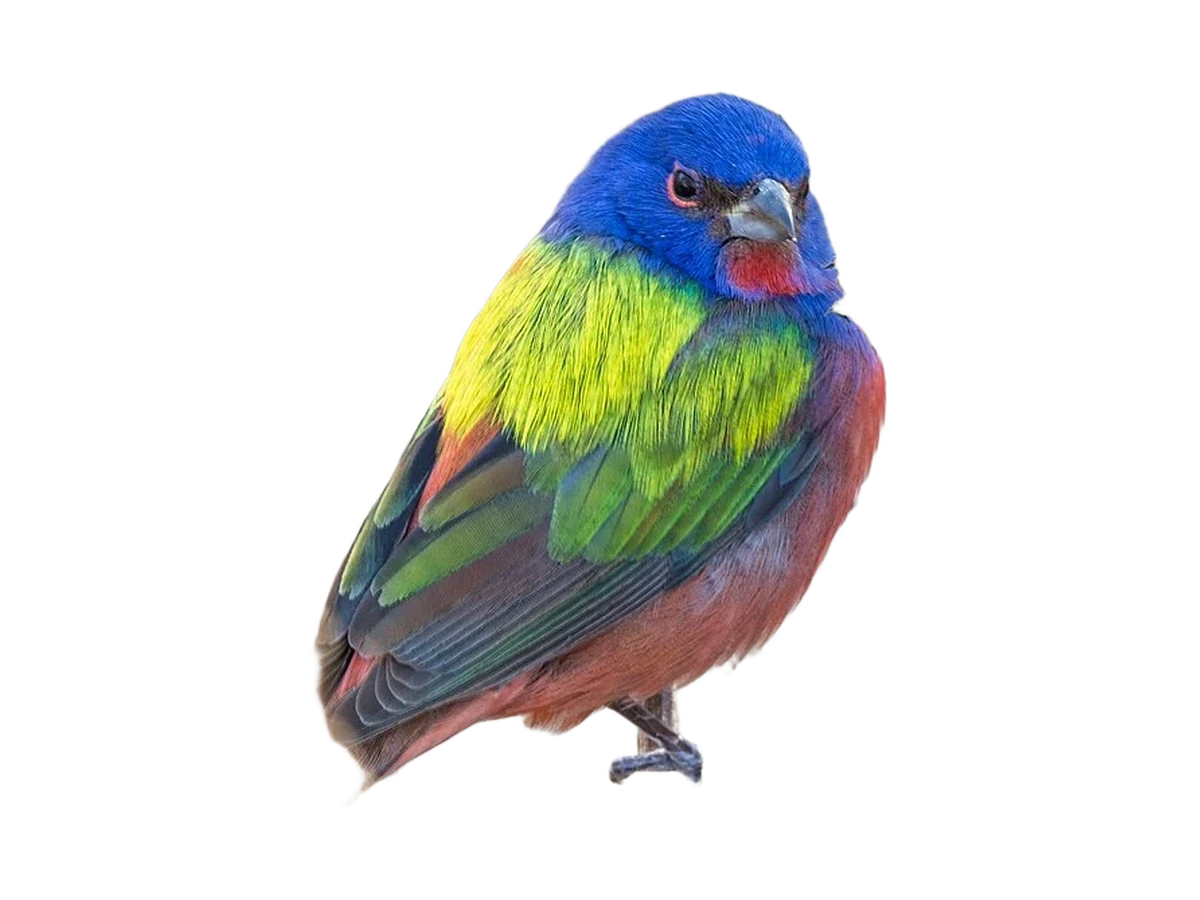
Male Painted Buntings combine vivid blue, green, yellow, and red-orange regions, while females and immatures are mostly bright green. The selected male photo supports color-placement and named-part study without turning every age and sex into the same pattern.
- Blue head on the selected adult male
- Green back and wings between blue and red-orange regions
- Red-orange underparts with a compact conical bill
Meet the bird
What kind of bird is the Painted Bunting?
Male Painted Buntings combine vivid blue, green, yellow, and red-orange regions, while females and immatures are mostly bright green. The selected male photo supports color-placement and named-part study without turning every age and sex into the same pattern.
Where to look
Where can you find the Painted Bunting?
Search seed-rich weedy edges and dense low cover, then listen for a metallic chip or a sweet rambling song before expecting the bird to emerge.
Listen in the field
What does the Painted Bunting sound like?
Painted Bunting males sing. This recording is identified as song in the original observation. Listen to the complete phrase and compare it with the bird's appearance and setting.
Painted Bunting song at Independence Creek Preserve, recorded by Clifton Ladd, C.W.B.
Open audio fileA source-classified Painted Bunting song recorded at Independence Creek Preserve, Texas.
Original recording by Clifton Ladd, C.W.B. · CC BY 4.0. Bird Tone stores the cited recording for reliable playback. The source creator amplified the WAV in Audacity 3.3.3; Bird Tone transcoded it to mono Ogg Vorbis at quality 5 without trimming and used FFmpeg bitexact muxing for reproducible Ogg bytes. The recording loads only when requested and plays only after you press play.
Source check
Where do these identification notes come from?
These notes summarize beginner-facing identification, habitat, and behavior cues. Confirm a bird from several marks, its voice, and the setting rather than one color alone.