
Species field guide
Shoebill identification guide
Balaeniceps rex · Shoebills · Balaenicipitidae
Observation focus
How to identify the Shoebill.
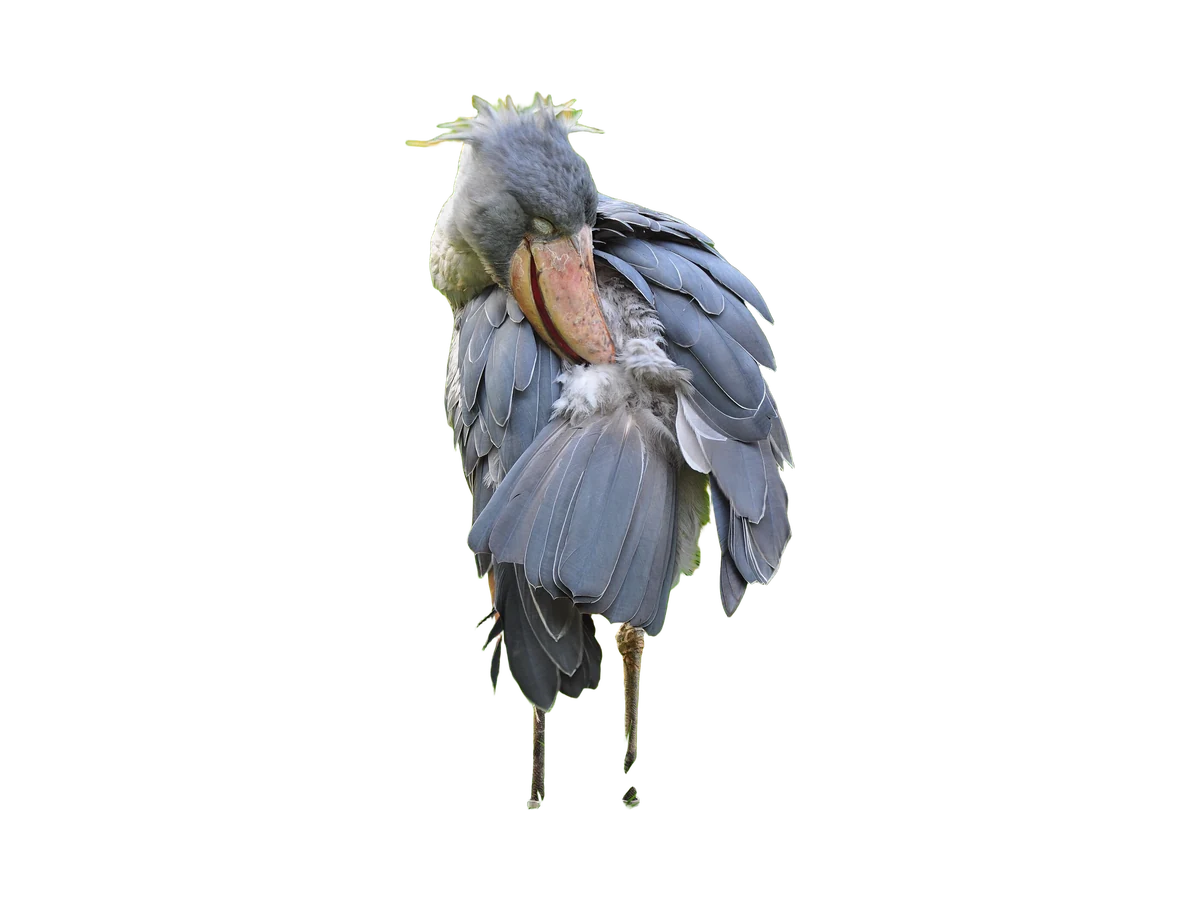
Shoebills are very large wetland birds defined by a massive shoe-shaped hooked bill, broad gray body, and patient upright posture. Bill clattering adds a mechanical sound cue to the same structure that dominates visual identification.
- Massive shoe-shaped bill with a hooked tip
- Broad gray body and heavy head
- Long dark legs beneath a slow upright wetland posture
Meet the bird
What kind of bird is the Shoebill?
Shoebills are very large wetland birds defined by a massive shoe-shaped hooked bill, broad gray body, and patient upright posture. Bill clattering adds a mechanical sound cue to the same structure that dominates visual identification.
Where to look
Where can you find the Shoebill?
Search extensive freshwater marshes for a large motionless gray bird, then confirm the deep body, long legs, and enormous hooked bill instead of relying on apparent size alone.
Listen in the field
What does the Shoebill sound like?
Shoebills use rapid bill clattering as a greeting and around nesting. The selected CC0 source explicitly identifies this mechanical sound.
Shoebill bill-clattering, recorded by Peter Handke
Open audio fileA Shoebill producing bill-clattering sounds used in greeting and nesting contexts.
Original recording by Peter Handke · CC0 1.0. Bird Tone stores the cited recording for reliable playback. Bird Tone replaced the confirmed 9.256-10.424 s human-speech interval with nearby ambience using two 100 ms crossfades, preserved the full duration and stereo layout, then encoded deterministic Ogg Vorbis at quality 5. The recording loads only when requested and plays only after you press play.
Source check
Where do these identification notes come from?
These notes summarize beginner-facing identification, habitat, and behavior cues. Confirm a bird from several marks, its voice, and the setting rather than one color alone.